




Feeling like you're juggling a dozen flaming torches is a pretty good way to describe managing multiple high-interest debts. If that sounds familiar, a Debt Management Plan (DMP) might be the structured solution you're looking for. It's a way to get a handle on the chaos by rolling your unsecured debts into a single monthly payment, usually with a much lower interest rate.
A DMP isn't another loan. Think of it as a guided repayment program designed to get you completely out of debt in about three to five years.
What Is a Debt Management Plan Really

Imagine a financial firefighter stepping in to help you manage the blaze. That's pretty much the role a nonprofit credit counseling agency plays when you sign up for a DMP. They don’t lend you money. Instead, they build a structured repayment plan that actually fits your budget.
As part of this process, the agency gets on the phone with your creditors for you. Their main goals are to slash your high interest rates—often dropping them from over 25% down to single digits—and to put a stop to the relentless collection calls.
How a DMP Works in Practice
Instead of stressing over sending payments to a handful of different creditors each month, you just make one manageable payment to the credit counseling agency. They take it from there, distributing the money to your creditors exactly as laid out in the plan. This move alone simplifies your financial life and gives you a clear, predictable path out of debt.
This structured approach is a big reason DMPs are so effective. A five-year analysis of over 14,000 clients found that an impressive 68.4% successfully completed their DMP and paid off their debts in full. Compare that to consumers just making minimum payments, who can stay stuck in a revolving door of debt for decades while paying mostly interest.
A DMP is built specifically for certain kinds of debt. Here’s what it usually covers:
- Credit Card Balances: This is the #1 reason people turn to DMPs.
- Unsecured Personal Loans: Any loan not backed by collateral like your car or house.
- Medical Bills: Overdue bills from hospitals or clinics that have been sent to collections.
- Store Cards: Those high-interest retail credit cards.
A Debt Management Plan is fundamentally about control. It takes a chaotic, stressful situation with multiple due dates and sky-high interest rates and transforms it into a single, predictable monthly payment with a clear finish line.
To see just how different the two paths can be, let's break down the numbers.
How a DMP Changes Your Debt Repayment
| Feature | Debt Management Plan (DMP) | Making Minimum Payments |
|---|---|---|
| Interest Rates | Negotiated down, often to 6-10% | Unchanged, often 20-30% or higher |
| Monthly Payment | One consolidated payment | Multiple payments to each creditor |
| Payoff Timeline | Fixed, typically 3 to 5 years | Unpredictable, often 10-30+ years |
| Total Paid | Significantly less due to lower interest | Much more due to compounding interest |
| Collection Calls | Cease once enrolled in the plan | Continue and may increase over time |
The table makes it obvious: a DMP gives you a structured exit ramp, while making minimum payments can feel like you're running on a treadmill, putting in effort but getting nowhere.
Who Offers These Plans
Legitimate DMPs are offered exclusively by nonprofit credit counseling agencies. These organizations are focused on financial education and helping you find a solution that actually works for your life. Picking the right agency is a huge part of your success.
If you're starting to explore your options, it's a good idea to compare some of the top debt management programs in America to see how the most reputable providers operate. This strategy provides immediate relief and a realistic roadmap for anyone feeling crushed by unsecured debt, helping you regain financial stability without resorting to more extreme measures like bankruptcy.
The Real Advantages of a Debt Management Plan
When you're stuck in a cycle of high-interest debt, it can feel like trying to fill a bucket with a massive hole in the bottom. No matter how much you pour in, the water level never rises. A Debt Management Plan (DMP) is designed to patch that hole by going straight to the source of the problem.
The benefits here are about more than just getting organized. A DMP fundamentally changes the math of your debt, shifting the odds back in your favor so you can finally make real, measurable progress.
Dramatically Reduced Interest Rates
This is the single biggest game-changer of a DMP. High interest rates are the engine that keeps your debt growing, sometimes faster than you can possibly pay it down. Your credit counseling agency gets to work negotiating with your creditors to slash those rates, often taking them from over 25% down into the single digits.
Think of it this way: trying to pay off a 28% APR credit card is like running up an escalator that's going down. A DMP stops the escalator. Suddenly, your payments start making a much bigger dent in the actual principal balance instead of just getting eaten up by interest.
This has a huge ripple effect, unlocking two other major wins:
- Thousands of Dollars Saved: Over the life of your plan, lower interest means you pay back far less money than you would have otherwise.
- A Faster Path to Zero Debt: With less cash going toward interest, your balances shrink way faster, potentially cutting years—or even decades—off your repayment time.
One Simplified Monthly Payment
Let’s be honest, juggling a half-dozen due dates, minimum payments, and different online portals is a huge source of stress. It’s way too easy to miss a payment by accident, triggering late fees and a hit to your credit score. A DMP wipes all that chaos off the table.
You make just one monthly payment to your credit counseling agency. That’s it. They take care of splitting it up and sending the right amounts to each of your creditors on time. This isn't just about convenience; it’s about freeing up your mental energy so you can focus on your budget and goals, not on remembering which bill is due Tuesday.
An End to Collection Calls and Late Fees
The constant, harassing calls from collection agencies can be incredibly disruptive. The good news? Once you're enrolled in a DMP and your creditors have accepted the new terms, those calls have to stop. Your creditors have agreed to the new plan, which gives you a much-needed break from the direct collection pressure.
On top of that, creditors often agree to waive or stop tacking on new late fees and over-limit fees as part of the deal. This is huge, as it stops your balances from continuing to inflate due to penalties. It ensures every dollar you pay goes toward chipping away at the actual debt.
The core benefits of a DMP—lower interest, a consolidated payment, and a defined payoff schedule—work together to create a powerful financial reset. It’s not just about managing debt; it’s about systematically eliminating it.
This combination of lower costs and a faster timeline delivers tangible, life-changing results. For example, a typical client starting with around $23,460 in unsecured debt at an average 28.04% APR saw their rate plummet to just 6.64% on a DMP. This shift was projected to save them over $48,000 in interest and 26 years of payments compared to just making minimums. If you want to dig into the numbers, you can review the research sponsored by the Federal Reserve Bank of San Francisco.
A Clear and Realistic Finish Line
This might be one of the most underrated benefits of a DMP: the psychological boost of having a clear end date. Instead of feeling like you're on a treadmill with no "off" switch, a DMP gives you a fixed timeline, usually somewhere between three and five years.
Knowing that every single payment gets you one step closer to a specific date when you'll be completely debt-free is incredibly motivating. It replaces that feeling of hopelessness with a sense of control and purpose, empowering you to stick with the plan and build a healthier financial future.
Understanding the Downsides and Tradeoffs

While the benefits of a Debt Management Plan (DMP) are a huge relief for many, it’s not a magic wand. This path comes with real tradeoffs you need to be ready for. Think of it as a serious financial commitment, not a quick fix.
Getting a clear-eyed view of these downsides is just as important as knowing the pros. It requires discipline, patience, and a willingness to change how you handle credit for a while. Let’s break down what you’re signing up for.
Restricted Access to Credit
This is the big one. As part of a DMP, you must close or freeze the credit card accounts enrolled in the plan. It’s not an arbitrary rule; it’s the core of the deal you make with your creditors. They agree to cut your interest rates because you agree to stop adding new debt to those accounts.
Basically, you’re putting your credit cards on ice. This step is non-negotiable because it forces a clean break from the spending habits that might have caused the debt in the first place.
But this has a real-world impact. For the three to five years you're on the plan, your ability to lean on credit for emergencies or big purchases is gone. It's a major lifestyle adjustment that demands a solid budget and careful planning.
The Costs and Fees Involved
DMPs are run by nonprofit agencies, but that doesn't mean they're completely free. The agency does a lot of administrative work behind the scenes, and they charge small fees to keep the lights on. It’s important to know what these are from day one.
You’ll typically see two kinds of fees:
- A one-time setup fee: This covers the initial work of getting your plan started and negotiating with your creditors. It’s usually between $30 and $50.
- A monthly administrative fee: This is an ongoing fee for managing your payments and keeping the plan running smoothly. It generally lands somewhere between $25 and $75 a month, depending on your state and the agency.
The good news is these fees are rolled into your single monthly payment, so you won’t get a separate bill. Any reputable agency will be totally upfront about its fee structure, and some might even waive them if your income is low enough.
A Long-Term Commitment Is Required
A DMP is a marathon, not a sprint. The average plan takes between three and five years to complete. Your success depends entirely on making that payment on time, every single month, without fail. There’s almost no wiggle room.
If you miss even one payment, you could put the whole deal in jeopardy. Creditors can pull the plug on your lower interest rates, sending them shooting back up and completely derailing your progress.
A Debt Management Plan is a structured partnership between you, the credit counseling agency, and your creditors. Success demands unwavering discipline and consistent adherence to the payment schedule for the full term of the plan.
This long-term commitment requires a stable income and a disciplined budget. Before you sign up, you have to be honest with yourself: can you stick to this plan for years, even when life throws you a curveball? It’s a huge pledge, but it’s one that leads to a debt-free life if you see it through. Fully understanding the debt management plan pros and cons, including this commitment, is the key to making the right choice.
How a DMP Affects Your Credit Score
Let's be honest, one of the first questions on anyone's mind is, "What will this do to my credit score?" It's a huge deal. Your credit score is your ticket to future financial goals, so it's smart to be concerned.
The relationship between a DMP and your credit score is a two-part story. There's usually a short-term dip, followed by a strong, steady recovery.
Think of it like rehabbing a sprained ankle. At first, you have to stay off it, which feels limiting. But after disciplined physical therapy, you eventually come back even stronger. A DMP works the same way for your financial health.
The Initial, Temporary Dip
When you sign up for a DMP, the credit counseling agency will usually have you close the credit card accounts in your plan. This is a critical step to stop the cycle of new debt, but it can cause a temporary drop in your score for two big reasons:
- Credit Utilization Ratio: Closing accounts lowers your total available credit. This makes your credit utilization ratio—how much you owe versus your total limit—spike up, which can hurt your score in the short term.
- Length of Credit History: If you're closing older accounts, it can shorten the average age of your credit history, which is another factor in your score.
On top of that, some creditors might add a note to your credit report saying the account is managed by a credit counseling service. While this isn't a negative mark like a default, it does signal to new lenders that you're in a repayment program. This is a normal part of the process and is way less damaging than a history of missed payments.
The initial dip in your credit score is a strategic trade-off. It’s a necessary move to break the debt cycle and set the stage for long-term credit health and stability.
The Positive Long-Term Rebound
Okay, so the initial phase can be a little unsettling, but the long-term outlook for your credit is where a DMP really shines. The whole point of the plan is to systematically improve the things that matter most to your score.
The single biggest piece of your credit score—making up 35% of the FICO model—is your payment history. A DMP is designed to help you build a perfect track record of on-time payments. Every single month, your counselor sends those payments to your creditors like clockwork, building a pattern of reliability that lenders love to see.
As you keep making these steady payments, two powerful things start to happen:
- Your balances shrink. This directly lowers your credit utilization ratio, the second most important factor in your score.
- You build a rock-solid payment history. Over time, this positive history starts to outweigh the initial hit from closing the accounts.
Over the three to five years of the plan, this disciplined approach completely rebuilds your credit profile. You're not just treading water anymore; you're actively wiping out debt while proving you can manage your finances responsibly. The structure of a DMP offers a clear advantage over just trying to wing it, but it's always smart to see how it stacks up against other options. You can learn more by exploring the credit implications of consolidation loans, which is another popular strategy.
By the time you graduate from the program, your debt-to-income ratio will be much lower, you'll have a history of consistent payments, and—most importantly—you'll have the habits to maintain a strong credit score for years to come.
Comparing DMPs With Other Debt Relief Options
A Debt Management Plan is a fantastic tool, but it's just one way to tackle debt. It's crucial to understand how it stacks up against the other big players: debt settlement, consolidation loans, and bankruptcy. Each one hits your finances, credit score, and even your stress levels in a totally different way.
Think of it like choosing how to get to a destination. A DMP is like a reliable commuter train. It follows a set schedule, has a predictable cost, and gets you there without any wild surprises. The other options might seem faster but carry bigger risks, or they might be slower and less structured.
Let’s break them down so you can pick the right ride for your journey.
Debt Management Plan Vs Debt Settlement
At first glance, debt settlement sounds almost too good to be true. The sales pitch is simple: they negotiate with your creditors to let you pay back less than what you actually owe. But this path is usually a rocky one with some serious downsides for your credit.
Here's the catch. To make a settlement happen, you typically have to stop paying your bills and send that money to a settlement company instead. As you can guess, deliberately missing payments absolutely tanks your credit score. Creditors might even decide to sue you for the unpaid balances while you're waiting for a settlement.
To get a clearer picture of how these two really differ, it helps to compare credit counseling vs debt settlement side-by-side. You'll see their core approaches and outcomes are worlds apart.
While debt settlement focuses on slashing your principal balance (what you owe), a DMP focuses on slashing your interest rate. A DMP helps you pay your debt in full, which is a much healthier move for your credit and financial future.
Debt Management Plan Vs Debt Consolidation Loan
A debt consolidation loan is another popular strategy. You take out a new, single loan and use it to pay off a bunch of your other debts. If you've got a great credit score, you might even snag a loan with a low interest rate, which simplifies your payments and saves you money.
The big "if" here is your credit score. Qualification depends almost entirely on it. If you're already struggling with debt and have missed payments, getting a new loan with a good interest rate can feel impossible.
A DMP, on the other hand, is usually way more accessible for people with fair or even poor credit. It's not based on your score; it's based on your ability to make a consistent monthly payment.
This flowchart shows what you can expect your credit score to do on a DMP—from the initial dip when accounts are closed to the steady growth that comes from making consistent payments.
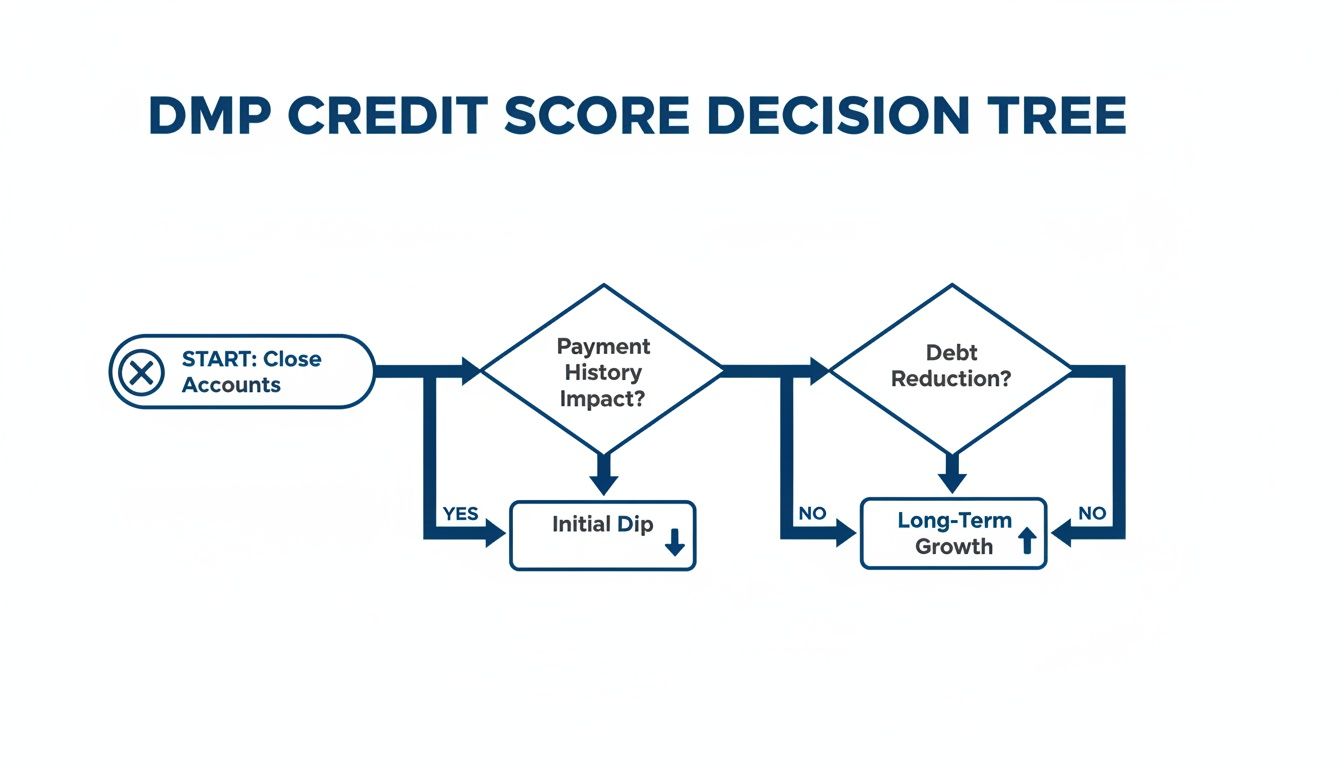
As you can see, a temporary dip is often followed by a strong, sustainable recovery as your on-time payment history improves and your balances drop.
Debt Management Plan Vs Bankruptcy
Bankruptcy is a formal legal process and the most extreme form of debt relief out there. Think of it as the absolute last resort, for when your debt has become totally unmanageable and no other options are on the table. While it can offer a fresh start by wiping out many unsecured debts, it comes with severe, long-lasting consequences.
A Chapter 7 or Chapter 13 bankruptcy stays on your credit report for seven to ten years. That makes it incredibly difficult to get new credit, a mortgage, or even certain jobs.
A DMP isn't a legal proceeding at all. While it takes discipline, it helps you repay your debts in full and rebuild your credit over a much shorter period—usually three to five years.
When weighing all your choices, especially if you have tax issues, it's smart to explore the Top 8 Tax Debt Relief Options to Consider.
Debt Management Plan vs Key Alternatives
To make things even clearer, let's put these options head-to-head in a simple table. This gives you a quick snapshot of how they compare across the factors that matter most.
| Factor | Debt Management Plan (DMP) | Debt Settlement | Debt Consolidation Loan | Bankruptcy (Chapter 7/13) |
|---|---|---|---|---|
| Primary Goal | Lower interest rates to pay off debt in full faster. | Pay a reduced principal balance. | Combine multiple debts into one loan with a lower interest rate. | Legally discharge or restructure overwhelming debt. |
| Credit Score Impact | Minor initial dip, then improves with on-time payments. | Severe, long-term damage due to missed payments. | Can improve if you get a good rate and pay on time. | Devastating, long-term negative impact (7-10 years). |
| Eligibility | Based on income and ability to pay. Accessible with poor credit. | Anyone can enroll, but success isn't guaranteed. | Requires a good-to-excellent credit score. | Must meet strict legal and income requirements. |
| Timeframe | Typically 3-5 years. | Highly variable, often 2-4 years or longer. | Depends on the loan term, usually 3-7 years. | Chapter 7 is fast (months); Chapter 13 is 3-5 years. |
| Cost | Small monthly fee and a one-time setup fee. | Fees are a percentage of the settled debt (often 15-25%). | Interest on the loan and possible origination fees. | High legal fees, court costs, and counseling fees. |
| Creditor Relations | Creditors agree to the plan and stop collection calls. | Creditors are not paid and may sue you. Calls continue. | Creditors are paid off, so relationships are fine. | Creditors are legally barred from collecting (automatic stay). |
Ultimately, a DMP often hits the sweet spot. It avoids the harsh credit damage of debt settlement and the legal severity of bankruptcy, all while being more accessible than a consolidation loan for those already feeling the financial squeeze. It provides a structured, supportive path to becoming debt-free without the extreme trade-offs.
Common Questions About Debt Management Plans
Even after weighing the pros and cons of a debt management plan, it's totally normal to have a few more questions. This is a big decision, and you want to be sure you have all the details before you jump in.
We’ve pulled together the most common questions people ask when they’re thinking about a DMP. The answers are straightforward, designed to give you that last bit of clarity you need to decide if this is the right move for you.
Who Is a Good Candidate for a Debt Management Plan
A DMP is often the perfect solution for someone who’s drowning in high-interest unsecured debt but still has a steady income. If you feel like you're just treading water by making minimum payments, or worse, watching your balances actually grow each month, a DMP can be the lifeline you need.
Think of it like hiring a personal trainer for your finances. You’ve got the ability to do the work (your income), but you need a pro (the credit counseling agency) to create a smart, effective plan that actually gets results.
It’s an ideal path for people who are committed to paying back what they owe but just can't get ahead of the interest charges. A DMP simplifies everything into one payment and cuts the interest rates down to a manageable level.
On the flip side, a DMP won’t help with secured debts like your mortgage or car loan, since those can't be included. It's also not a fit if you've lost your income and can't make any kind of consistent monthly payment.
A strong candidate for a DMP is someone caught in the high-interest trap. They have the income to pay their bills but are losing ground to interest charges each month. The plan offers them a way to finally make progress.
Can All Types of Debt Be Included in a DMP
This is a really important one to get straight: only unsecured debts can go into a Debt Management Plan. That means any debt that isn't tied to an asset, like a house or a car.
Here are the usual suspects that qualify for a DMP:
- Credit Card Debt: This is the #1 reason most people sign up for a DMP.
- Unsecured Personal Loans: Think loans from a bank or credit union that didn't require you to put up collateral.
- Medical Bills: Past-due balances from doctors or hospitals, especially those in collections.
- Payday Loans: In some cases, these high-interest, short-term loans can be rolled in.
Now for what’s not included. Secured debts, like your mortgage and auto loans, are out. You have to keep paying those separately to protect your assets. Federal student loans are also excluded because they have their own set of government-run repayment and assistance programs.
When you start the process, your credit counselor will do a full review of everything you owe. They’ll tell you exactly which debts can be included in the plan and which ones you'll have to handle on your own.
What Happens If I Miss a Payment on My DMP
Missing a DMP payment is a big deal and something you should try to avoid at all costs. The whole plan relies on the deal your credit counseling agency struck with your creditors, and that deal is built on your promise to make steady, on-time payments.
If you miss one, you put the whole agreement at risk. Creditors could pull the plug on the benefits they gave you, like those lower interest rates and waived fees. Your rates could shoot back up to their original levels, which would blow up your budget and likely kill the plan.
That said, most agencies get that life happens. If you run into a temporary snag, like a surprise car repair or medical expense, they usually have a grace period and will try to work with you.
The key is to be proactive. If you think you’re going to have trouble making a payment, call your credit counselor right away—before it's late. They might have options, but if you consistently miss payments, your DMP will almost certainly be canceled, and you’ll be right back where you started.
How Do I Choose a Reputable Credit Counseling Agency
Picking the right agency is probably the single most important decision you'll make. A good one will be your advocate and guide, but a shady one can make a bad situation even worse. Your success really depends on finding a trustworthy partner.
Here’s what you need to look for to make sure you’re dealing with a legitimate organization:
- Nonprofit Status: Only work with nonprofit agencies. Their mission is to help you, not to turn a profit on your debt.
- Accreditation: Check for accreditation from trusted national organizations like the National Foundation for Credit Counseling (NFCC) or the Financial Counseling Association of America (FCAA). Think of it as a seal of approval that proves they meet high industry standards.
- Transparent Fees: A good agency is totally upfront about costs. You should expect a small, one-time setup fee (usually $30-$50) and a monthly administrative fee (around $25-$75). If anyone asks for a huge upfront payment, run.
- Free Consultation: Reputable counselors always offer a free, no-pressure initial session. They’ll review your budget, go over all your options, and tell you honestly if a DMP is even the right choice for you.
Be very skeptical of any for-profit company promising to slash your debt for "pennies on the dollar." That’s the sales pitch for debt settlement, which is a completely different (and much riskier) ballgame. A great credit counselor is an educator first, focused on giving you the information you need to make the best decision for your future.
Trying to figure out debt on your own can feel overwhelming, but you don’t have to. If you're ready to see what your options are and find a clear path forward, DebtBusters can connect you with trusted debt relief professionals who are vetted for their expertise and commitment to helping people like you. Get a no-obligation consultation today and take the first step toward regaining control of your finances. Visit https://debtbusters.com to learn more.